The text Wikipedia followed by a puzzle piece with a 25 inside of it

Celebrating Wikipedia’s 25th Birthday – and Reflecting on Being a Wikipidean for 21 Years

Today marks 25 years since the first edit to Wikipedia! And what an amazing trip it has been! The Wikimedia Foundation (WMF) has a website celebrating the day: https://wikipedia25.org/en/ They also have an outstanding video:

They also have posts, images and videos on all the major social networks, including TikTok and Instagram Reels.

In fact, if you go on any social network and search for the hashtag #Wikipedia25, you’ll find many posts!

My First Edit in 2004

I joined Wikipedia on April 21, 2004, so I’m coming up on 22 years as a “Wikipedian”. It’s amusing to look back on my early edits. It was SUCH a different world then. No one knew what Wikipedia would become at that time!

It was just one of the many different sites and services around that were trying out different ways of displaying and sharing information. And “wiki” software was a big deal at that time (as a 2005 LiveJournal post captures).

Looking back at my first edit, it is somewhat ironically what we would call today a “COI edit” for “conflict of interest” – I added the link to Mitel’s website to the Mitel Wikipedia article, something that would be frowned upon today because at the time I worked for Mitel. (See the page in 2004 – and then today – a BIG difference!) But at the time, those conventions weren’t around yet, and everyone was experimenting – and I wanted to make the article accurate by having a correct URL.

My early edits are amusing as they reflect my interest in both geeky security technology and podcasting – and also quirky aspects of living in Canada! 🤣
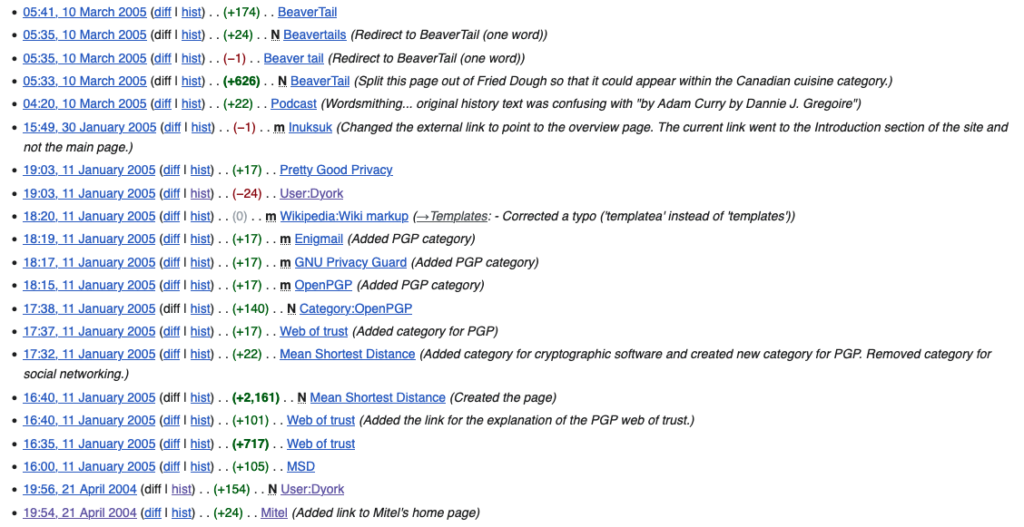
A long list of Wikipedia edits from April 2004 through March 2005, mostly of security-related topics.

In truth, I didn’t do a whole lot of Wikipedia editing. I would go in from time to time and make an edit or two, but there were years when I did almost no editing. In fact, I made zero edits in all of 2008, only 1 in 2012, and only 2 in 2007.

Between 2004 and 2019, I only made a grand total of 146 edits!

And Then Came The Pandemic

And then came March 2020 and the start of COVID. The Governor of Vermont declared a state of emergency and issued a “Stay at Home” order. Suddenly I was trapped in my 10-foot x 10-foot home office (as other family members were working in other parts of the house) and I needed to do something for my mental health.

My post from January 2021 tells the longer version of the story… but essentially… I wanted to dive deeply into livestreaming using OBS Studio and Twitch… and I also wanted to dive into the Wikipedia community… and so I decided that I would start livestreaming Wikipedia editing on Twitch! 🤣
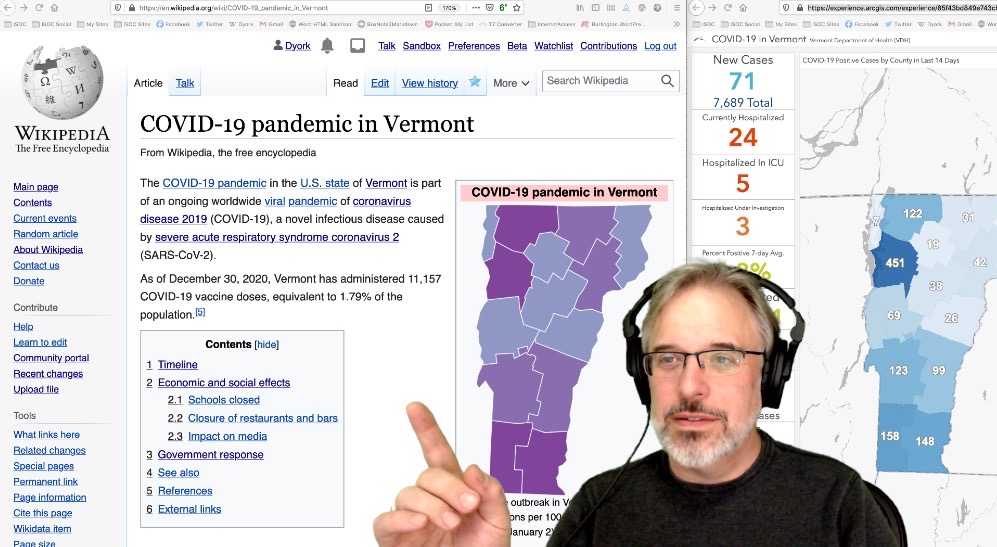
Screen capture of a computer screen with two wikipedia pages of the state of Vermont, with one titled "COVID-19 pandemic in Vermont", with an image of Dan York in front of those screens.

And I kept doing so… EVERY … SINGLE … DAY… FOR AN ENTIRE YEAR! 🤯

I would go in each day and start out updating the COVID-19 pandemic in Vermont page with the latest stats pulled from a Vermont government site. And then I’d go into my watch list and start going down looking for scammers, spammers, and people just doing stupid things on the pages I monitored.

It worked! I learned a HUGE amount about livestreaming, OBS Studio, Twitch, and so much more. And I deepened my own expertise with Wikipedia, and also my respect for so much of the amazing Wikipedia community. I never had many people watch any streams… maybe a handful at any time. But a few became “regulars” and it became a way to connect each night – two of whom I’ve continued to stay in touch with since that time.

There were also the random people who, once they realized that yes, indeed, I was actually editing Wikipedia… they often had all sorts of questions! And so it became a time to also teach people about Wikipedia and what it was all about. It was fun!

And the stats showed how much more I edited:
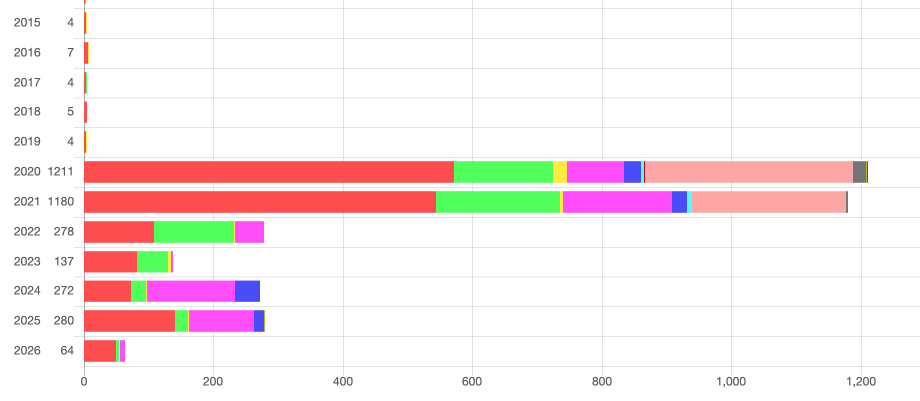
A horizontal bar chart showing edits from Dan York. From 2015-2019, the bar is tiny with a number between 4 and 7. Then in 2020 it is a LONG bar with 1211 edits, then 1180 in 2021, and then smaller bars for the years 2022-2026 with most of the bars around 275 edits. The bars are multi-colored showing different kinds of pages being edited.

Boom! I jumped up to 1,211 edits in 2020 and then 1,180 edits in 2021 before dropping to a level around 275 edits in the past few years.

Now… this still makes me small-scale editor. There are some editors who do 1,200 edits in a week, or at least a month. But for me, a guy who took a half-hour or less each day to go and do some edits, it was a good bit of work.

The irony is that 6 years later, all of that has fallen into dis-use. I thought about doing a livestream to celebrate the 25th birthday today but… the computer I used for all that streaming died, and I never even installed OBS Studio on my current computer. šŸ¤¦ā€ā™‚ļø Getting it all set-up again takes more time than I have today. But I may get it back together again soon… it was fun to do! (I’m danyork324 on Twitch if you want to be alerted if I start again.)

Wikipedia… as a Trusted Source?

25 years after its launch, Wikipedia has emerged as, ironically, a bastion of truth in an online world full of AI slop and disinformation. 20 years ago the advice was to “never reference anything from Wikipedia” because “anyone can create pages” and so you can’t trust it at all! Teachers and professors disparaged it and told students everywhere they couldn’t use it.

And yet the Wikipedia community of editors developed the practices, the guidelines, the conventions, the tools, and the systems (like watch lists) that have enabled the site to evolve in ways that have created reliable information.

It’s not perfect, of course. Vandalism happens, and people can inject false information that gets missed by other editors. But overall… it works pretty well. And in a time of “hallucinations” and the inability to tell truth from fiction, Wikipedia provides one place where you can usually get a decent answer.

Whither Wikipedia?

So what about the next 25 years? I think the answer is… it’s complicated.

There’s a range of challenges:

  • Consumers are rapidly using generative AI chatbots to get answers … and those chatbots are often not indicating that the source is Wikipedia. And so people don’t learn about Wikipedia – and don’t know that they can update Wikipedia. (And also don’t feel compelled to help Wikipedia by either volunteering or donating.)
  • AI bots are relentlessly scraping Wikipedia.. which has an impact on Wikipedia’s infrastructure.
  • AI “slop” is invading Wikipedia articles… some people are using AI LLMs to create new Wikipedia articles and then posting that info into Wikipedia without checking for accuracy šŸ¤¦ā€ā™‚ļø (There is a whole team of editors who are spending time trying to weed out this kind of garbage.)
  • Policymakers are creating policies that may impact Wikipedia … in some places it is a desire to age-gate Internet content, including Wikipedia, so that children can’t access info. In some places it is concerns about political bias in Wikipedia articles. In some places law enforcement wants to get the names of editors who change articles (and Wikipedia won’t give out that kind of info). In still other places, some governments just don’t like people having access to information, especially that might be critical of their government.
  • The changing media landscape reduces the number of “reliable sources”… every week, it seems, more and more of the traditional media outlets are closing, often being replaced by smaller organizations or individuals who may focus more on opinion or outrage than on factual documentation.This makes it harder for editors to find sources that can be trusted.
  • It can be hard for people to get started with editing Wikipedia… I had to laugh when looking back at my old posts. Back in 2006 I apparently went in during a lunch break and created three Wikipedia articles as “stubs”, and invited other people to fill them in. That wouldn’t happen any more.. bots within Wikipedia or some of the editors on new page patrol would probably have speedily deleted those pages with little info. The bar for quality has been raised higher! And overall that’s a good thing! But it does mean it is harder to get started with your first pages or ideas. (And yes, there are definitely some editors who are overly pedantic and some are simply mean to newcomers. But many of the rest of us are not… and try to be kind and welcoming!)
  • There’s a lot of chaos and uncertainty in the world right now … and a lot of economic uncertainty, which often means people don’t have the time they may have had before to volunteer to do the work that is needed to do.
  • And…
  • And…

There’s a LOT of pressure on Wikipedia’s future. A lot of challenges and choices ahead.

But on the positive side… there is an amazing community of people around the world working to include the world’s knowledge. And there is amazing work creating a multilingual Internet with increasing amounts of content being available in so many languages other than English. And the Wikimedia Foundation (WMF) is doing some excellent work defending Wikipedia (and other WMF sites) and trying to develop more editors and encourage more people to update the site.

So many challenges… and yet so many people working to continue the vision and spirit of Wikipedia.

As the WMF folks are saying on this 25th birthday: “the future of knowledge is yours to protect!

May we all work together to see that Wikipedia can grow and thrive even more over the next 25 years!

P.S. For my own part, I’ve made a commitment to see if I can edit Wikipedia every day of 2026… I’ve done good so far, but it’s only been 15 days! 🤣 Let’s see how long I go…
An Excellent Read: The Verge on how “Google shapes everything on the web”

If you want to understand how we got to the Web that we have today, I would strongly recommend reading this beautiful piece by Mia Sato at The Verge on the theme of ā€œGoogle shapes everything on the Webā€

It is an interactive piece that explains in both text and animations why it is that search engine optimization (SEO) has driven every website to look the same… why even short articles are being broken up by headings… why author bylines are suddenly expanding into bios…  … and why the #Web is increasingly bland, useless, and untrustworthy

It also explains why increasingly people are using other search experiences (ex TikTok) – or moving content into other systems – purely because the Web is no longer working in the way it used to. It’s now gamed by so many… and filled with generative-AI spawned content farms….

Certainly some of us keep posting to our good old websites or blogs… largely because they were and are labors of love, not profit.

But those seeking profit or fame are all playing the SEO game… and we with our regular old websites will lose out on the discovery.

I thought one of the final paragraphs was on point about the paywalling of content (my emphasis added):

But no matter what happens with Search, there’s already a splintering: a web full of cheap, low-effort content and a whole world of human-first art, entertainment, and information that lives behind paywalls, in private chat rooms, and on websites that are working toward a more sustainable model. As with young people using TikTok for search, or the practice of adding ā€œredditā€ to search queries, users are signaling they want a different way to find things and feel no particular loyalty to Google.

People are looking for alternatives, and increasingly they are moving to private communities / walled gardens in large part to avoid the spam… and to avoid the blandness and overall "enshittification" of the Web.

The Rise of AI-driven ā€œVirtual Influencersā€ (to no surprise)

Visit ā€œAitana Lopezā€ on Instagram. As you scroll down, the account looks like that of any of the hundreds (or thousands) of ā€œinfluencerā€ accounts on Instagram. ā€œAitanaā€ post photos from her travels, of her wearing various clothes, and making references to various brands. 

Except… it’s fake.

As described on Ars Technica, this account is a complete fabrication developed by an ad agency in Barcelona. 

Why? Because they found that regular human ā€œinfluencersā€ were starting to charge to much.

And so they wanted a cheaper way for their customers to advertise.

And so ā€œAI-tanaā€ was created. To be fair, they are very open about it being AI-generated. It’s right there in ā€œherā€ bio. 

But other ā€œvirtual influencersā€ will not be so clear. And you won’t be able to know if an account is real or virtual.

Now, let’s be honest, that can also be the case today without generative AI. You can have an Instagram account with photos that come from stock photography or some other service – or could be of someone else.

But generative AI just makes this SO much easier.

And there’s no surprise… advertisers have always been looking for ways to pay less for advertising. This is just the natural evolution.

The Curious Aspect of Facebook Supporting Multiple Personas

I find it fascinating that Meta just announced the ability of Facebook users to have multiple accounts attached to their single Facebook account. So you can have different ā€œpersonasā€ for interacting with different communities differently.

Now, this is nothing very new. We’ve had this in the Fediverse since its beginnings. You can have as many accounts on different instances as you want. And many apps let you seamlessly switch between them. I use the Ice Cubes app for Mastodon on my mobile devices, and with the tap on an icon in the lower right corner of the app, I can switch to a different profile. Other social media services have had this capability, too.

But why I find this fascinating is that my memory is that for so long, Facebook did NOT want you to do this. They promoted the notion that you used your ā€œreal nameā€ and that Facebook was a place where you could go to interact with real people, not potentially anonymous people. And in fact they seemed to encourage the blending and blurring of work and personal lives.

I remember this being a big deal to them – and something that differentiated Facebook from other services that allowed anonymity or pseudonymity.

Or at least that is what I remember. And so it is fascinating to see the pivot to allowing people to have different accounts for different facets of their lives. Which DOES reflect the reality of how most of us like to interact with people online.

Whether this incentivizes more people to use Facebook, I don’t know. I’ve decreased my time there mostly because of their extremely privacy-invasive systems. Multiple personas will not bring me back. But I am only one person. What about you? Will this make you do anything more on Facebook?

43% of the Web Can No Longer (Easily) Auto-Share to Twitter

IMG_3651

As of today, May 1, 2023, 43% of web sites will no longer be able to easily auto-share posts to Twitter. I’m referring, of course, to WordPress, which W3Techs shows as powering around 43% of all sites they scan.

Due to the continued incomprehensible decisions being made by Twitter’s new management, the company behind WordPress, Automattic, has stated that they have discontinued the easy auto-sharing of posts through their hosted WordPress.com service, and also through the Jetpack Social service used by many people (myself included) who operate their own WordPress instances.

The issue is that Twitter decided to start charging for API access, and as Automattic notes:

The cost increase is prohibitive for us to absorb without passing a significant price increase along to you, and we don’t see that as an option. We have attempted to negotiate a path forward, but haven’t been able to reach an agreement in time for Twitter’s May 1 cutoff. 

When you publish a new post on WordPress.com or any WordPress site using Jetpack, it will no longer be automatically shared out to Twitter. You can, of course, manually copy and paste the URL from your site over into Twitter. And you can potentially use some other auto-sharing plugin that has decided to pay Twitter’s API fees. 

Now of course all 43% of web sites using WordPress did NOT use this auto-sharing capability. Many sites did not, but many did – and this allowed Twitter to be the place where you could be notified when someone you followed published something new.

Of all the many ridiculous decisions Twitter’s management has made in the past six months, this excessive changing for API access seems to me to be one of the MOST short-sighted decisions.

One of the reasons I used Twitter was to get the latest news and content. Now Twitter is reducing the amount of content that will be shared.  The API limits are expected to affect public service announcements – and now will affect the sharing of blog posts.

I get that Twitter’s new owners desperately need to figure out ways to make money, but this doesn’t seem to be the right one.

In my mind, if you want your social service to be THE place for people to go for the latest news and content, then you want to reduce any friction involved with posting content INTO your service. 

The reality is that you (Twitter) need that content far more than the content providers need you!

The Good News

There was some good news in the post from Automattic – specifically that they will soon be adding Mastodon auto-sharing, as well as Instagram:

However, we’re adding Instagram and Mastodon very soon. In the meantime, auto-sharing to Tumblr, Facebook, and LinkedIn still works as expected

I don’t personally care as much about the IG linkage, but the Mastodon auto-sharing will be hugely helpful, as that is where I am spending most of my social time these days. There are no API fees there, and content can be shared in many ways. 

You can already do this auto-sharing to Mastodon using ActivityPub plugins, but this announcement indicates it will be brought more into the main WordPress / Jetpack functionality, which will make it that much easier for people to use.

I look forward to trying the Mastodon sharing out when it becomes available!

Meanwhile… this announcement means there are even fewer reasons for me to be checking Twitter anymore. Sad to see the continued decline. šŸ™


Cory Doctorow on the enshittification of social platforms

The word enshittification on a blue and white gradient

If you read nothing else this week, I encourage you to read Cory Doctorow’s latest … rant? … essay? … article?

Written in a style uniquely his own, he calls the article ā€œTikTok enshittificationā€, giving us an ever so appropriate new word. Here’s his intro:

Here is how platforms die: first, they are good to their users; then they abuse their users to make things better for their business customers; finally, they abuse those business customers to claw back all the value for themselves. Then, they die.

I call this enshittification, and it is a seemingly inevitable consequence arising from the combination of the ease of changing how a platform allocates value, combined with the nature of a “two sided market,” where a platform sits between buyers and sellers, hold each hostage to the other, raking off an ever-larger share of the value that passes between them.

By the title, you would think it would focus only on TikTok, but in fact he walks through how this behavior happened on:

  • Amazon
  • Facebook
  • TikTok
  • Cryptocurrencies/Web3
  • Twitter
  • Amazon Smile
  • Google Search

And in the midst he brings it all the way back to the Netheads vs Bellheads debates of the 1990s.

I enjoyed the post because we’ve seen this cycle happen… SO… MANY… TIMES….

New startup launches and everybody gets excited and starts using it for free. At some point the company has to make enough money to keep paying people – and to pay their investors,Ā because they want to grow. And so the start making choices that ultimately follow this path.

The post was also a sad reminder of how much we’ve lost since some of the earliest days when companies like Google set out with a mission “to organize the world’s information and make it universally accessible and usefulā€. That’s still their mission, in fact, but with so many people trying to game their algorithm, and with so much advertising involved, the results are no longer what they once were. (And we’ll see if they are challenged by ChatGPT and other generative AI systems.)

Toward the end, he hits a key point:

Enshittification truly is how platforms die. That’s fine, actually. We don’t need eternal rulers of the internet. It’s okay for new ideas and new ways of working to emerge. The emphasis of lawmakers and policymakers shouldn’t be preserving the crepuscular senescence of dying platforms. Rather, our policy focus should be on minimizing the cost to users when these firms reach their expiry date: enshrining rights like end-to-end would mean that no matter how autocannibalistic a zombie platform became, willing speakers and willing listeners would still connect with each other

Many years ago, friends of mine wrote ā€œThere are no permanent favouritesā€ as part of what they termed the Internet Invariants.

The point is that platforms and services come and go. Some have their dominance for a few years, some for many years. But in the end the siren song of ā€œenshittificationā€ is often too much to resist. The cycle continues.

Midway Through 100 Days of Blogging – How Did I Do?

100 Days of Blogging FAIL

Back on December 1, 2022, I boldly said that I was going to attempt 100 consecutive days of blogging. Today marks day 50, the halfway point. So.. how did I do?

Wellll… how many different ways can you say…

FAIL!

I started out strong. From December 1 to 15 I published every single day. Then I missed December 16th, published on the 17th, and missed again on the 18th. Then I had a four-day run from the 19th to 22nd, missed the 23rd, and then a five-day run from the 24th through 28th.

Then I missed the 29th, published on the 30th, and missed the 31st. And then,Ā the only post I have published so far in January 2023 was on January 1.

So includingĀ this post you are reading now, I will have published 28 posts in 50 days, which comes in atĀ 56%.

Many reasons… each one small in its own way… but the end result is that I stopped.

And yet the point was to try to push myself intoĀ getting BACK into the routine of writing every single day.

I have a LOOOOOONNNGGGGGG list of topics… I… just… need… to…. WRITE!

<CTRL>+<ALT>+<DEL>

Let’s do a reset and see what happens. 100 days fromĀ today isĀ April 29.Ā Fifty days from now will beĀ March 10.

Let’s check in there and see whether this is going to happen or not! šŸ˜€

Mastodon Tip – Filter Languages To See Only The Ones You Understand

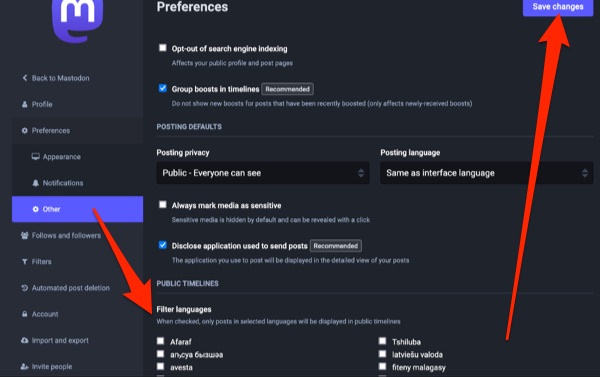
Screenshot of Mastodon preferences panel allowing you to filter posts based on languages

A tip for all the newcomers to Mastodon – if you are seeing a lot of posts in your timelines in languages that you don’t know, there is a very simple way you can filter those posts out. You just:

  • In the web client, click on the gear icon to go into Preferences
  • Select the ā€œOtherā€ panel under Preferences (see screenshot above)
  • Scroll down to ā€œFilter languages”
  • Check the boxes next to the languages that you want to see
  • Scroll up to the top and press the ā€œSave changesā€ button

Now your Mastodon timelines will only show you posts that indicate they are in the languages you have specified.

I made this change a few years back because I’m on a larger instance, and on the rare occasions when I actually looked at the Local timeline, it was full of posts in so many wonderful languages… but only a few of them I could actually understand. So I went into these preferences and changed it so that I only see posts in the three languages I know (at least somewhat): English, German, and French.

One important caveat – these filters are based on *the language the post indicates it is written in*. If you look at the screenshot above, in the middle right side you see a ā€œPosting languageā€ that is set as ā€œSame as interface languageā€. And back on the main Preferences screen I have set my ā€œInterface languageā€ to English.

So all my posts are set by default to be in English. However, if I decide to go in and write a post in German or French,Ā by default it will go out to everyone on Mastodon as ā€œEnglishā€.

And so even with the filters on, youĀ might still see posts in other languages if the author has their Mastodon client set to default to one of the languages you want to see.Ā But setting these language filters should remove many of the posts in languages you don’t understand.

Setting a Post’s Language

BUT… what if you are a multilingual person and you want to post in multiple languages and allow people to filter based on languages?

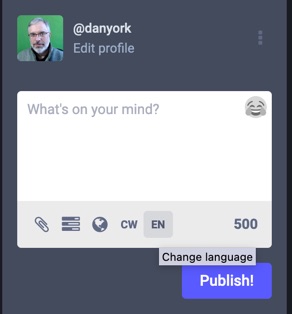
InĀ the web view of Mastodon, it’s very simple. When you are writing a post, you simply go to the bottom of the compose window where you will see the two letter abbreviation for whatever your default language is. Mine shows ā€œENā€ as English is my default.

screenshot of the window for posting a message to Mastodon showing the menu to change the language

When you press that language, you get a popup menu where you can change it to whatever language you are writing in.Ā 

This changes the language settingĀ ONLY for the post you are writing.

As soon as you hit ā€œPublish!ā€ and the compose window returns to being blank, the language will be reset back to your default language.

So if I wanted to send out a series of German posts or replies,Ā I would have to REMEMBER TO CHANGE THE LANGUAGE SETTING for every single post. Which, to be honest, I will probably forget to do.

Additionally, I cannot find a way to change the language setting for a postĀ in the Mastodon mobile app. When I go into the compose window, I see many options, but not to set the language. Some of the many other mobile apps may have this language support, but the one maintained by the Mastodon development team does not.

For both those reasons – people having to remember, and support on mobile clients – people writing in different languages may have the posts going out as whatever their default language is.

The point being that the language filters are great to have and can help adjust your timelines so that you are seeing content in only languages that you understand – you just need to know that they are not 100% perfect.Ā 

Regardless, I’m very glad that they are there!

Ā 

Techmeme Now Highlighting Mastodon Posts In Addition to Tweets

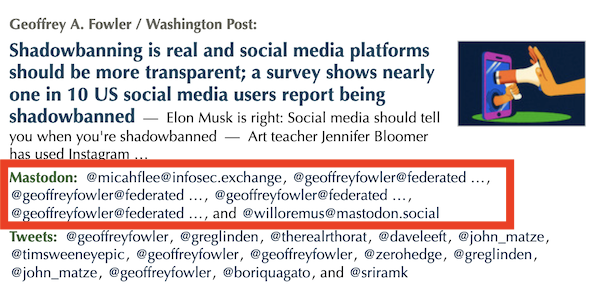
Screenshot of a section of the Techmeme.com news site with a red box around a section of Mastodon posts.

In a sign of the growth of Mastodon in the midst of the continuing drama at Twitter, Techmeme, the news site I use the most to keep up on tech news, has started to highlight Mastodon posts in addition to the way the site highlights tweets. In fact, in an interesting bit of prioritization, the site puts Mastodon postsĀ first before tweets.

If you go to Techmeme.com now, you can see the Mastodon sections for some articles that are discussed on Mastodon. It’s actually an interesting view into what groups of people have moved from Twitter to Mastodon.

For example,Ā at the moment when I am writing this article, the top of Techmeme has 9+ stories all around cryptocurrencies, the FTX debacle, and the latest news of more bankruptcies and other issues. There are no Mastodon sections but this makes sense as most of ā€œcrypto twitterā€ seems to be sticking with Twitter right now… or trying to look at other ā€œweb3ā€ social media.

However, when you get past all the cryptocurrency stuff, the next current article is about LastPass and has aĀ large Mastodon section… because a substantial amount of the Twitter ā€œinfosecā€ / security communityĀ has moved to Mastodon.

Other articles such as the one I show in the image above have a more balanced mixture of Mastodon posts and tweets. (Although seeing the prevalence of ā€œ@geoffreyfowlerā€, I’m guessing he is cross posting between Mastodon and Twitter and Techmeme’s algorithm has picked up both.) Another example shows the Mastodon posts and tweets combined in a single block (at the time I’m writing this).

It’s great to see this recognition of the growth of Mastodon’s usage. It’s also great because it shows to all the readers of Techmeme who are NOT yet on Mastodon that there *are* conversations happening on Mastodon. Perhaps this may cause some others to try it out!

Techmeme is, of course, on Mastodon themselves. You can follow them at https://techhub.social/@TechmemeĀ (or search for “@techmeme@techhub.socialā€ in your Mastodon account).

P.S. As a daily reader of Techmeme, I noticed this change when it was happening, but I must give a tip of the hat to Will Oremus who was the first I saw posting about this change on Mastodon.Ā 

ACM Launches Public Mastodon Server – Mozilla Planning To Launch Fediverse Instance in 2023

The text "MOAR mastodon!!!" on a blue and white gradient background

It’s great to see nonprofit organizations getting into the business of operating public Mastodon / Fediverse instances. Two announcements recently caught my attention.

First, Mozilla, the makers of Firefox, announced that they would launch a public server (ā€œinstanceā€) in early 2023:

In early 2023, Mozilla will stand up and test a publicly accessible instance in the Fediverse at Mozilla.Social. We’re eager to join the community in growing, experimenting, and learning how we can together solve the technical, experience, and trustworthiness challenges inherent in hyper-scale social systems. Our intention is to contribute to the healthy and sustainable growth of a federated social space that doesn’t just operate but thrives on its own terms, independent of profit- and control-motivated tech firms. An open, decentralized, and global social service that puts the needs of people first is not only possible, but it’s absolutely necessary.

Now, they did not specifically say it would be a *mastodon* instance, although I’ve seen many people assume it will be. But if they use some other Fediverse / ActivityPub software, that’s perfectly fine! It will just be great having Mozilla in the Fediverse with their lengthy experience in operating Internet systems at scale.

Second, the 75-year-old Association of Computing Machinery (ACM), has already launched their own publicly available instance at mastodon.acm.org. From their intro message, that includes the link to join:

Hi there! This is ACM, the world’s largest computing society. As you might have noticed, we have opened not only our official #Mastodon account but also our own #instance!Ā 

Please consider joining @mastodon.acm.org, a community for #computing researchers & practitioners to connect & exchange ideas with each other, whether you are an ACM member or not.Ā 

They’ve also tweeted about it and from the server stats it seems 548 people have so far joined.

Addressing The Two Major Challenges

The importance of these entities relates to what I described as two major challenges for operating Mastodon servers: scaling and content moderation.

If we are to bring millions of more people (or even 10s or 100s or millions) into the Fediverse, we will need many more servers. It will be helpful if we have some servers operated by companies or organizations that know how to operate Internet infrastructure at scale. This is what excites me most about Mozilla. With their operation of the Firefox browser, plus services like Pocket and their VPN product, they understand how to do this. They can potentially help provide an example for others.

I don’t know much about whether the ACM can also address the scaling (I’m not a member), but it’s good to see organizations like this getting into the space. The ACM’s announcement, though, does highlight the challenge around content moderation. Already, a couple of people are asking for specifics around content moderation:

screenshot of two Mastodon replies asking the ACM for more details around their content moderation policies

And another apparent member was questioning the ACM’s ability to manage a server.

These are questions that organization will have to be ready to handle.

As Mozilla gets ready to launch their server, they can expect to be similarly grilled about what level of moderation they will or will not do.

It’s tough to find the right balance – which is why I think organizations have to be sure they are ready to commit the necessary staff time, energy, and finances before they plunge into it.

Regardless, I think it is great for both Mozilla and ACM to be entering the Fediverse with their own servers. I wish them all the best!